Collections stewardship · Attribution integrity · NAGPRA

A cataloging instrument for archaeological objects

The Grammar of Things builds an evidence-based visual record for collections where attribution claims outrun documentation. It reads what the object itself shows — separate from what the paperwork says.

See the complete analysis →

Developed for IMLS National Leadership Grants for Museums. Designed to be built and transferred to a museum or consortium for long-term institutional stewardship.

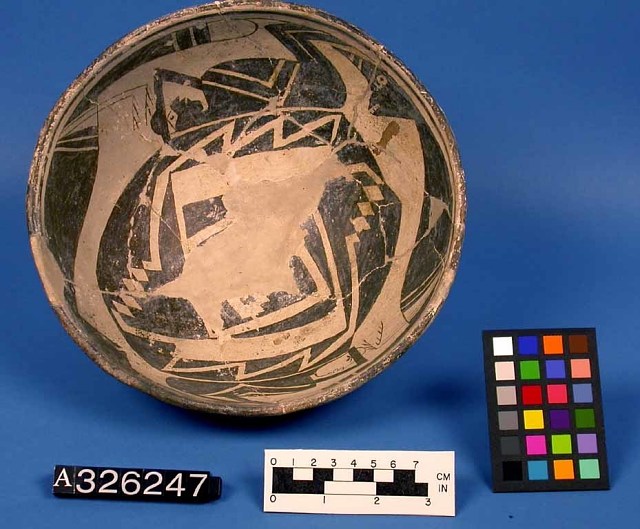
Bowl A326247 — interior Interior
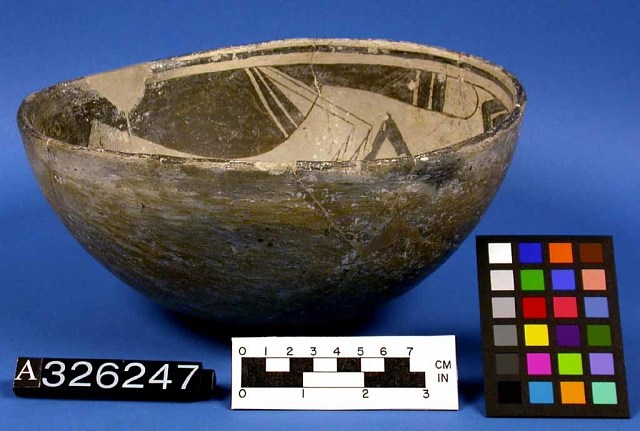
Bowl A326247 — exterior Exterior

Bowl A326247

Mimbres · Luna County, NM · 1923

NMNH, Smithsonian Institution

Read complete analysis →

[OBS] 7 direct observations [CONS] 5 scholarly anchors 27-principle fingerprint

Attribution claims outrun documentation

A large share of Southwest archaeological objects in U.S. museum collections carry attribution claims that rest on dealer notes, incomplete field records, or acquisition documentation from decades ago. The documentation system was never designed to handle the scale of what was collected.

Attribution errors matter on two fronts. For scholarship, they distort the record — misattributed objects train wrong analytical models and anchor false comparisons. For repatriation, they obstruct it: NAGPRA claims depend on accurate cultural affiliation, and a misattributed object is a claim that cannot be processed.

The standard response — more documentation — is necessary but insufficient. Physical examination and laboratory analysis can resolve many cases, but the backlog is in the hundreds of thousands of objects. What is missing is a systematic first-pass instrument: something that reads the object itself and compares what it shows against what the paperwork claims, before a specialist opens a single cabinet drawer.

"What the eye can read from a photograph is not nothing. It is a systematic, reproducible signal — if you know how to read it."

Project framing
27 perceptual principles scored per object
4 epistemic stances — observation, interpretation, consensus, theory
0 cultural assumptions in Pass 1 — the fingerprint is computed blind

One real object, read all the way through

The tool was run on a real object — a Mimbres Black-on-white bowl collected in 1923, held at the National Museum of Natural History. What follows is a sample of what it produced. Every claim is anchored.

From Pass 2 — artifact analysis

The slip and paint program routes this object through CHECK 1 of the tradition identification matrix: brilliant white to cream slip with a single dark pigment [OBS] routes to CHECK 2 (Mimbres vs. Ancestral Puebloan disambiguation). [CONS] CHECK 2 resolves immediately: the interior-dominant central medallion composition, angular stepped-diamond geometric program, single pigment, and coil-and-scrape construction all converge on Classic Mimbres Black-on-white. [CONS — Brody 2004, Shafer 2003]

The composition exhibits a designed positive-negative relationship: dark angular forms and white ground channels read interchangeably as figure and ground. [OBS] This is a structural property of how the composition was built — a specific technical achievement Brody identifies as the core formal accomplishment of Mimbres geometric work, not a byproduct of black-on-white contrast alone. [INTERP — Brody; Mimbres geometric only]

Sample — 6 of 27 perceptual principles

ap_1
3 Production Trace Reading
ap_8
3 Symmetry as Evidence
ap_10
3 Color Zone Logic
ta_1
3 Edge Detection
ta_4
3 Figure-Ground Relationships
ta_15
3 Closure / Negative Space

+ 21 more principles scored · full fingerprint in the analysis

Bowl A326247

Mimbres · NMNH Smithsonian · Accession 070367

  • Complete Pass 1 blind observation
  • Full Pass 2 analysis with epistemic labels throughout
  • 3 RAP Protocol flags with anchor counts
  • All 27 principle scores with plain-English descriptions
  • Pass 3 competency transfer
  • Fingerprint vs. attribution comparison
Read the complete analysis →

Four passes, one object

The key idea: separate what the eye can see from what the paperwork claims. The fingerprint is computed before the documentation is consulted. The comparison happens after.

01

Observe

Blind fingerprint

The tool reads the image as pure physical evidence: surface marks, color zones, construction traces, wear patterns. No cultural assumption enters at this stage. The documentation is deliberately excluded. This is the blind fingerprint — what the object shows before the paperwork is consulted.

Output: 27-principle perceptual vector stored against the object record.

02

Interpret

Analysis with context

With documentation now available, the tool applies Southwest archaeological frameworks — Brody on Mimbres iconography, Shafer on production sequence, Hegmon on social organization — to name what the evidence means. Interpretive claims require two independent observations. Claims with fewer are labeled hypotheses, not readings.

Epistemic labels [OBS] [INTERP] [CONS] [THEORY] mark every claim throughout.

03

Take forward

Competency transfer

What did this analysis make visible? What habits of looking did it demonstrate? This pass translates the analytical moves into a form that applies to the next object encountered — not this object specifically, but the class of things this object taught you to see.

Written for the person who received the analysis, not for the object.

04

Extract

Structured record

The analysis output is mapped to a structured record: tradition identification, confidence level, function category, RAP flags, and the full scored vector. This feeds the growing fingerprint database and enables future cross-object comparison.

The fingerprint from Pass 1 is compared against the documented attribution claim here. A significant mismatch is surfaced as a research flag — not a conclusion.

What photography can and cannot determine

Honesty about limits builds more trust than polish. The tool states its evidentiary ceiling explicitly in every analysis.

Image analysis can determine

  • Object class and approximate form
  • Surface treatment and design program
  • Cultural tradition and approximate temporal placement
  • Probable function category
  • Kill hole presence and method
  • Line quality and brush discipline
  • Construction technique indicators

Image analysis cannot determine

  • Actual dimensions (no scale reference)
  • Wall thickness or temper type (requires laboratory analysis)
  • Paint chemistry — mineral vs. carbon (requires physical examination)
  • Absolute age (requires radiocarbon or thermoluminescence dating)
  • Residue identity — what the vessel held (requires organic residue analysis)
  • Site association or provenience (requires documentation)
  • Associated assemblage (requires documentation)

When analysis reaches the ceiling, the tool says: "Visible evidence suggests X. Confirmation would require physical examination / laboratory analysis / provenience documentation." It does not hedge everything — it marks the specific limits where they exist.

What exists today, and what funding builds

The prototype demonstrates the method. The grant funds the corpus. Without a documented reference collection to compare against, the fingerprint is a vector without a baseline. That is what the next phase builds.

Prototype today

Single-object analysis

Upload an image, paste the documentation record, run Passes 1–4. The fingerprint is computed blind and compared against the attribution claim.

Epistemic labeling

Every claim in the analysis is marked [OBS], [INTERP], [CONS], or [THEORY]. Interpretive claims require two independent observations.

RAP Protocol

The Rigorous Attribution Protocol flags claims with insufficient anchors as hypotheses. It cannot be turned off — it is structural.

Three-layer documentation

Raw paste → AI-structured JSON → canonical mapped fields. EZID/ARK, catalog number, accession number, and culture attribution are promoted to first-class fields.

27-principle fingerprint vector

Stored per object in canonical order. Ready for vector similarity search when the reference corpus exists.

With funding

Reference corpus

critical

Documented benchmark objects from excavated contexts — Swarts Ruin, NAN Ranch, Pueblo Bonito. Objects with known provenience, primary-source-supported tradition attribution, and physical analysis data. This is what the fingerprint comparison will be measured against.

Vector similarity search

high

Once the corpus exceeds ~500 objects, query by fingerprint pattern: "show me the 20 objects whose Pass 1 scores most resemble this one." The schema is shaped for it today; the pgvector migration runs with the corpus.

Outlier detection

high

Flag objects whose perceptual fingerprint diverges significantly from the fingerprint distribution of their documented tradition. Candidates for closer physical examination. The embryonic misattribution instrument — presented as a research flag, not a conclusion.

NAGPRA support layer

high

Surface repatriation candidates systematically: objects whose fingerprint aligns with a different tradition than their documented attribution become priority cases for provenience research. The tool produces evidence for the conversation; it does not resolve it.

Multi-institution open corpus

longer term

A publicly queryable fingerprint database. Museums contribute objects; the corpus becomes a shared resource. Deaccession and repatriation workflows can pull from it. Long-term stewardship by a museum or research consortium.

The misattribution instrument is not presented as working today. It is presented as the rigorous path from a proof of concept to a validated instrument — one that requires a documented reference corpus before it can make meaningful comparisons. That corpus is what the grant builds.

Built for the long run

The tool exists to serve collections stewards, not to capture them. The goal is an open, community-maintained instrument with a clear transfer path.

Southwest archaeology expertise

The analytical frameworks draw on J.J. Brody, Harry Shafer, Michelle Hegmon, and Polly Schaafsma — the primary-source scholarship that defines how Mimbres, Ancestral Puebloan, Hohokam, and Casas Grandes material is evaluated.

Forensic-science partnership

Methodology is being validated in collaboration with NFS forensic-lab partners. The epistemic labeling system and RAP Protocol enforce the same evidentiary standards applied in forensic documentation.

Independent from the market

Analysis is grounded in excavated, documented reference assemblages — not unprovenanced market examples. The fingerprint corpus is built only from objects with known provenience.

Design intention: build the instrument, validate it against a documented corpus, and transfer stewardship to a museum, tribal organization, or research consortium with long-term care capacity. Funders own the result.