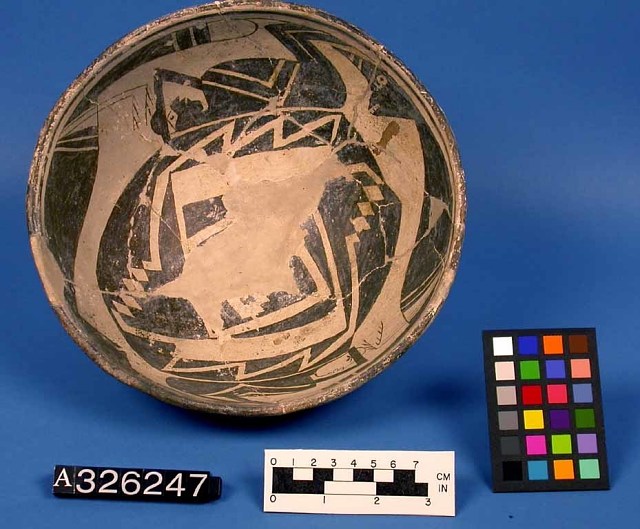
This is a bowl somebody made about a thousand years ago. We'll get to all that. First — look at it. Don't read anything yet. Ten seconds. Notice whatever you notice.
Look at the black shapes. Now look at the pale shapes in between them. Which ones are the design — the black, or the white?
Both. The potter painted the black, and shaped the white at the same time — the empty spaces are drawn just as carefully as the painted ones. Once you see the white as shapes, you can't unsee it.
Doing that freehand, on the inside of a curved bowl, is hard. Most people can't pull it off on flat paper.
Run your eye across the surface. See the thin lines that don't belong to the painting? Pick one and trace it.
Those are cracks. This bowl was broken — and somebody put it back together. Maybe a thousand years ago, maybe in a museum lab last century. We can't tell just by looking, and that's worth sitting with. What we can say for sure: this thing got dropped, or buried, or crushed, and somebody cared enough to save it.
A pot doesn't last a thousand years by being left alone. It lasts because people keep choosing to keep it.
Let your eyes relax and follow the big shapes. Do they sit still — or do they go somewhere?
They spin. The shapes are set at angles so nothing sits flat or square, and your eye gets pulled around the center like a pinwheel. The bowl turns while you look at it, even though it's holding perfectly still.
That motion is a choice. A bowl is round, so the potter built a design that uses the roundness instead of fighting it.
How many colors of paint do you count? Then a second question — flip to the outside of the bowl. What's out there?
One color. One dark paint and the bare clay — that's the whole palette. And the outside is almost blank. They put everything on the inside, the part you see when there's food in it, or when someone holds it up to you.
One color forces every decision onto shape and spacing. Nowhere to hide a weak line.
Find the spot where thin lines fill a shape like stripes. Look close at those lines. Are they perfectly even?
No — and that's the tell. Those stripes got brushed on one at a time, probably with a chewed yucca leaf for a brush. The spacing wavers a little. A line drifts. A person painted this freehand, no ruler, no pencil underneath, no way to undo a mistake.
Every wobble is a decision that couldn't be taken back. That's the nerve it took to make this.
Last one. You've found how it was made and how it moves. Now the hard question — what does the design mean?
We don't really know. It's tempting to say the shapes stand for water, or mountains, or clouds. Maybe they do. But that's us guessing, with our eyes, a thousand years late. The people who made it didn't leave a key — and a guess dressed up as a fact is how bad history gets written. Seeing clearly means knowing where the seeing stops.
That line — between what you can see and what you're guessing — is the whole game. You just walked it.
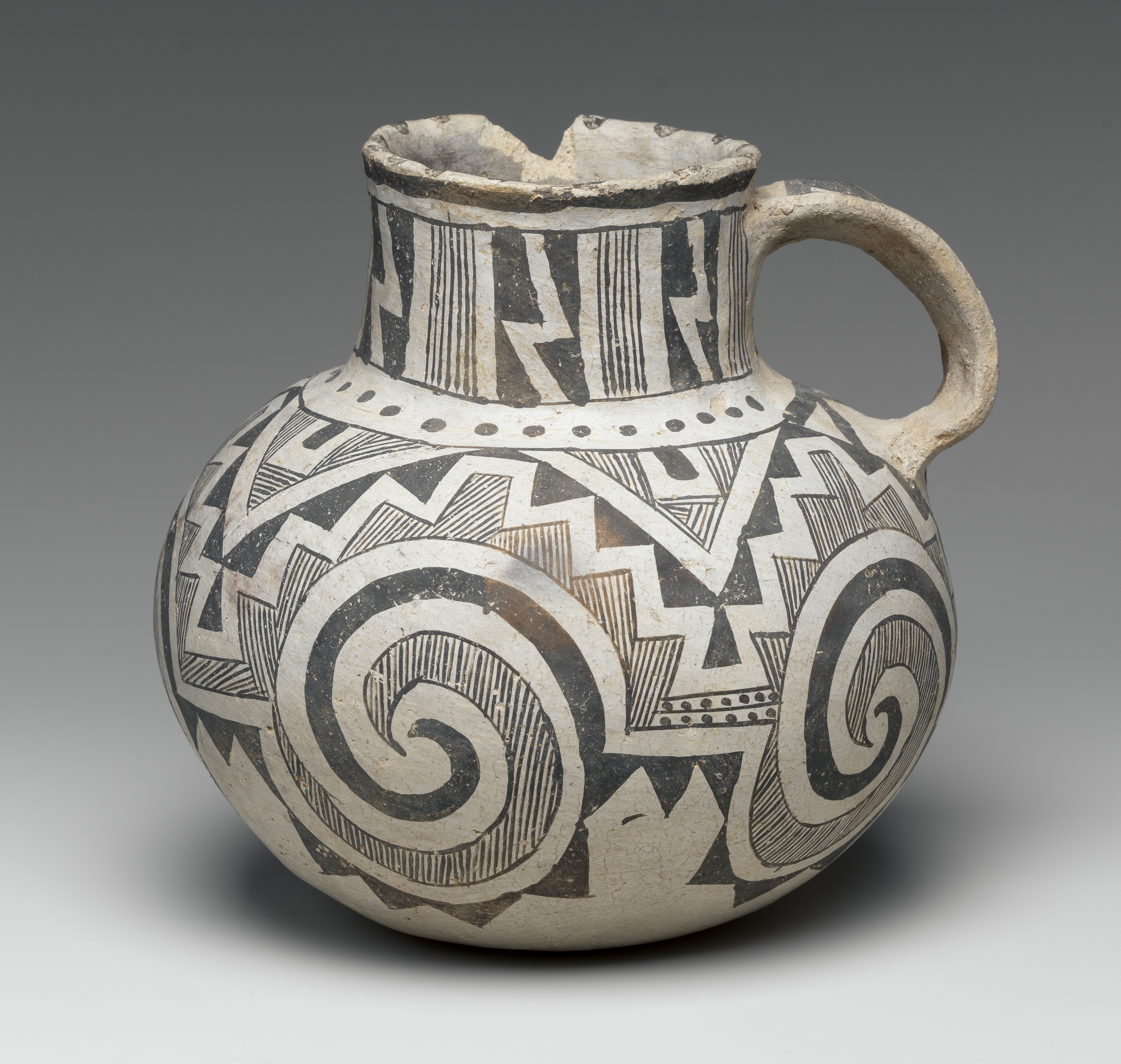
Pitcher. The Metropolitan Museum of Art. Public domain.
Your turn. Here's another pot — a pitcher this time, with a neck and a handle. Nobody's going to point. Look at it for a while. Find one thing. How it was made, how it moves, where it got hurt — anything.
See the two big spirals? They wind your eye inward and set the whole pot turning — same trick the bowl pulled, a different way. You already know how to spot this.
Look at the top edge. Pieces are missing — the rim's been chipped and broken. Like the bowl, this thing has been through something and survived it.
Look inside the dark shapes — they're filled with thin lines, brushed by hand, one after another. Get close and the spacing wanders. A person did this, freehand, the same way they painted the bowl.
One paint again, on bare clay. And look at the white zigzag between the dark shapes — the empty space is a shape too. You caught that on the bowl. Here it is again.
So what do the spirals mean? Same honest answer as before: we don't know. People love to say a spiral is water, or wind, or a journey. Maybe. But the potter didn't leave a note, and a good guess isn't a fact. You knowing the difference — that's the part that matters.
Same five moves. A different pot. That's not luck — it's a method, and it's yours now. You walked in able to see an old jar. You're walking out able to read one.